
 Our Centers


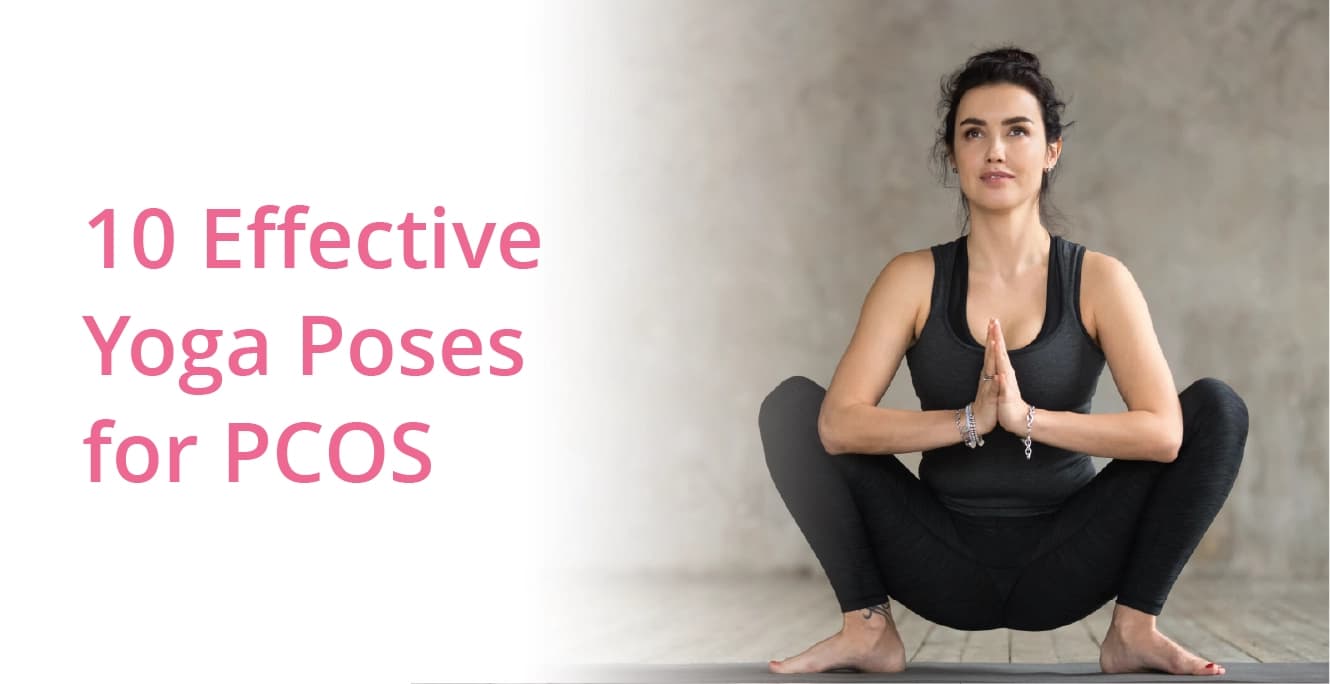
5 Effective Yoga Poses for PCOS

Table of Contents
Living with PCOS can feel overwhelming.
Irregular periods, weight changes, mood swings, and constant worries about hormonal health can make you feel drained.
But if you thought only medications work for PCOS, then you are mistaken. There are other gentle and natural ways to support your body. Out of all the options, yoga for PCOS can be a great place to start.
Yoga doesn’t just help you stretch or relax; it helps reduce stress, balance hormones, and promote overall well-being.
Women generally turn to yoga for PCOS problems because it not only supports the body, but the mind as well. Specific yoga asanas for PCOS treatment can help improve blood circulation, reduce stress hormones, and support better ovarian function. Over time, with a little consistency, yoga for PCOS and hormonal imbalance can bring control back into your life.
Let’s understand it in detail.
How Yoga Helps in Managing PCOS
Yoga can help you manage the symptoms of this ailment, but it cannot cure it.
Many women often wonder whether to go for yoga or the gym for PCOS. While the gym primarily focuses on weight loss, yoga works holistically on hormones, stress, and flexibility, making it especially beneficial for individuals with PCOS and thyroid concerns.
Yoga lowers testosterone levels by balancing hormones. Additionally, it reduces stress, worry, and depression, all of which are significant causes and consequences of PCOS. According to an Indian study, yoga can assist in regulating endocrine function and lessen PCOS symptoms. Additionally, it has been noted that after practicing yoga, triglyceride levels significantly decrease, the luteinizing/follicle-stimulating hormone ratio improves, and sex hormone-binding globulin levels increase.
Best Yoga Asanas for PCOS
A variety of asanas are included in yoga positions for PCOS. Nonetheless, we’ve listed some beneficial yoga positions that might be especially helpful for PCOS in the section that follows.
1. Kapalbhati Pranayam
Anyone can hold this yoga pranayama with ease, and it’s an essential part of body cleaning.
How to execute Kapalbhati?
- Make sure to sit with your back straight and your hands on your knees, palms facing the sky.
- Take a deep breath.
- Ensure you can feel the contraction of your abdominal muscles and that your navel is being drawn toward your spine as you start to exhale.
- To finish one cycle of Kapalbhati, take 20 of these breaths.
- Make sure to close your eyes, unwind, and experience your body’s sensations after every round.
- You should complete three rounds of Kapalbhati.
Benefits of Kapalbhati
- Boosts the body’s metabolism and enhances lung health
- Improves blood circulation and aids in digestion
- Reduces oxidative stress
2. Baddha Konasana Or Butterfly Pose
How to execute the Baddha Konasana?
- Keep your hands by your sides and sit erect on the ground with your legs outstretched.
- When you stay in this position, keep your spine and neck straight.
- As you move both of your legs closer to your torso, start breathing in.
- When your feet are facing each other, and your legs are still in contact with the ground, bring them closer to your torso.
- Exhale after maintaining the same posture for at least six seconds.
- As you exhale for three counts, slowly extend your legs back to the beginning position.
Benefits Of Baddha Konasana
- Improves the hip and groin muscles’ movement
- Facilitates bowel movements and digesting
- Helps remove the weariness associated with prolonged standing or walking
- Enhances concentration
- Helps with decreasing menstrual discomfort
3. Chakki Chalanasana
How to execute the Chakki Chalanasana?
- Sitting with your legs widely apart will help you achieve the starting stance. Put your arms forward at shoulder height and clasp your hands together.
- Take a deep breath and shift your upper body to the right and forward. Next, attempt to rotate your entire body in a clockwise direction.
- Breathe in and out as you move your upper body forward to the right and backward to the left.
- While holding this yoga pose, take deep breaths and ensure you complete at least five to ten cycles in each direction.
Benefits Of Chakki Chalanasana
- Aids in avoiding sciatica, which is discomfort in the sciatic nerve that travels from the lower back to the hips.Ten)
- Aids in strengthening the muscles of the arms, back, and abs.
- Help in avoiding pain associated with menstruation
- Frequent exercise may even help reduce belly fat
4. Shavasana
Shavasana is typically performed at the end of a yoga practice because it allows the muscles to experience the most relaxation and recovery.
How to execute Shavasana?
- Lie flat on your back, ideally without any cushions, to start. You can use a little pillow under your neck if needed. For even more relaxation, close your eyes.
- Maintain a comfortable distance between your legs, with your toes facing the sides and your feet and knees fully relaxed.
- Place your arms slightly apart next to your torso. Your palms should remain open and facing up.
- If at all possible, we advise you to enter a state of concentration during Shavasana and let go of all your worries and thoughts.
Benefits Of Shavasana
- Helps in relieving stress
- Helps in reducing anxiety and insomnia
5. Padhma Sadhna
Padma sadhana, also known as padmasana, is a form of deep meditation.
How to execute Padhma Sadhna?
- To begin, fold your right leg inward and softly bend it at the knee.
- Now, with the right foot’s sole facing upward, place the right heel on top of the left thigh with the help of your hands.
- Similarly, place your left heel on your right thigh with the soles facing up, so that the ankles cross. The heels should ideally be positioned close to one another.
- As much as your body permits, press both knees towards the floor while keeping in touch with the ground.
- Ensure your head, neck, and trunk are in a straight line, and your body is positioned in a pleasant, upright posture.
- You now have two choices, depending on your preferences. You can place your hands on top of each other, right below your navel, with your palms facing up, firmly resting them on your lap, or fold them in the “namaste” position.
- As you sit in your favourite position and concentrate on your breathing, alternate your legs periodically.
Benefits Of Padmasana
- Helps with sciatic pain
- Alleviates period pain
Best Time for Practicing Yoga
The best time to practice yoga is during the Brahma Muhurta, which is between 4:30 and 6:00 a.m. The weather during the morning is most serene, which makes it perfect for yoga. It also increases flexibility, awakens the body, and creates a good mood for the day.
If you have a busy morning and are not able to find out time, then evenings can work too. You can decompress and unwind after a demanding day. The secret is consistency; pick a time when you can practice frequently, have a light stomach, and have few distractions. When you incorporate yoga into your everyday practice in a balanced way, it works best.
The Bottom Line
Yoga for PCOS and thyroid management offers a gentle yet powerful way to support hormonal balance, mental well-being, and overall health. You must practice it regularly to reduce stress, enhance reproductive health, and improve metabolism. This is all done while minimising excessive strain on the body. For more such tips, keep reading our wide array of blogs at Birla Fertility & IVF.
FAQs
Can yoga cure PCOS permanently?
Yoga cannot cure PCOS permanently, but it surely helps reduce the symptoms. It especially helps regulate the hormonal imbalance, which is the main cause behind PCOS.
Can yoga help regulate irregular cycles?
Yes, yoga can certainly regulate irregular cycles by reducing stress and improving hormonal balance. Regular practice also supports better blood circulation and overall reproductive health.
Which yoga pose is best for weight loss?
Surya Namaskar is known as one of the most popular yoga poses for losing weight.
Does Surya Namaskar help with PCOS?
Yes, regular practice of Surya Namaskar can help manage PCOS by improving hormonal balance, reducing stress, and supporting healthy weight management.
Our Fertility Specialists

Kolkata New Town, West Bengal
Dr. Aaheli Maiti
MBBS, MS (Obstetrics & Gynaecology)


Siliguri, West Bengal
Dr. Angana De
MBBS, MD, Fellowship in Reproductive Medicine
Vijayapura, Karnataka
Dr. Ashwini Karjol
MBBS, MS, FRM

Koramangala, Karnataka
Dr. Manjunath CS
MBBS, MS (OBG), Fellowship in Gynaec Endoscopy (RGUHS), MTRM (Homerton University, London UK)

Chennai, Tamil Nadu
Dr. Shyla Usman Ali
MBBS, DGO, DNB(OBGYN), MRCOG-1, Advanced Diploma in ART and Reproductive Medicine
Indore, Madhya Pradesh
Dr. Payal Jaiswal
MBBS, DGO, FRM

Koramangala, Karnataka
Dr. Snehadarshini Karanth
MBBS, MS (Obstetrics & Gynaecology), FRM
Related Blogs






To know more
Birla Fertility & IVF aims at transforming the future of fertility globally, through outstanding clinical outcomes, research, innovation and compassionate care.


Had an IVF Failure?
Talk to our fertility experts