
 Our Centers
 Select City


 Select City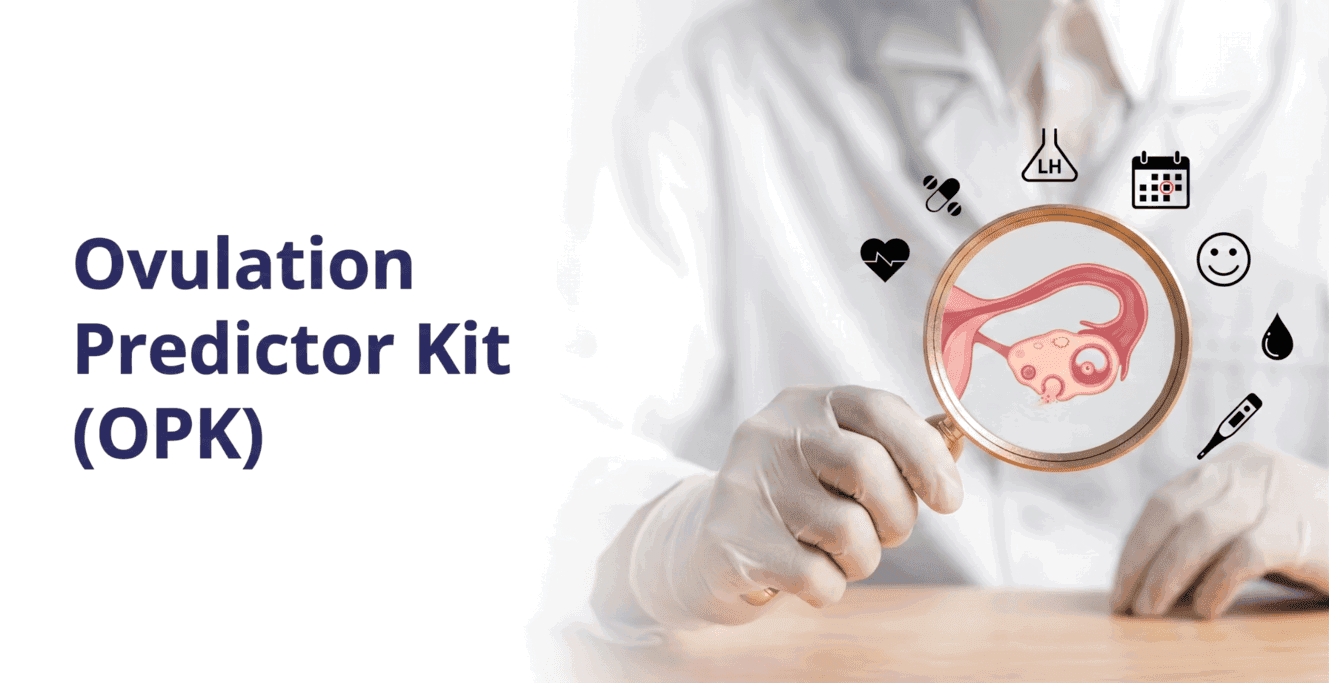
How to Use an Ovulation Predictor Kit (OPK)?

Table of Contents
- What is an Ovulation Predictor Kit (OPK)?
- How Does an Ovulation Predictor Kit Work?
- When Should You Start Testing with an Ovulation Predictor Kit?
- Ovulation Predictor Kit: Step-by-Step Guide
- How to Read Ovulation Test Results?
- What is the Best Time to Have Intercourse?
- Common Mistakes When Using an OPK
- OPK in PCOS
- OPK vs BBT
- Cost of Ovulation Predictor Kit
- Frequently Asked Questions (FAQs)
If you are trying to conceive, you may become more aware about your menstrual cycle. You may start tracking your periods, noticing changes in cervical mucus, or wondering whether you are actually ovulating or not. Predicting your ovulation pattern has now become easier and you can do it at your home as well.
An Ovulation Predictor Kit (OPK) is made to make this process a little easier. It is a simple urine-based test that looks for a rise in luteinising hormone (LH), which usually happens shortly before ovulation. In other words, an OPK can help identify the days when you are likely to be most fertile.
But there is an important distinction: an ovulation test predicts the hormonal surge associated with ovulation; it does not prove that an egg was actually released. Understanding how to use an ovulation test kit, when to test and how to interpret the result can help you use it more effectively.
What is an Ovulation Predictor Kit (OPK)?
An Ovulation Predictor Kit, commonly called an OPK or ovulation test kit, is a home fertility test kit used to detect the rise in luteinising hormone (LH) in urine. LH normally remains at relatively low levels during most of the menstrual cycle. Before ovulation, there is a temporary rise called the LH surge. This surge generally occurs around 1–2 days before ovulation. Detecting it can therefore give you an idea that ovulation may be approaching.
OPKs are available in different forms as urine strips, midstream tests and digital devices. The exact instructions and interpretation can differ between products, so it is important to follow the instructions supplied with your particular kit.
How Does an Ovulation Predictor Kit Work?
The basic principle is straightforward. You test a urine sample for LH, and the kit detects whether LH has risen above a particular threshold.
A positive result suggests that an LH surge has been detected and that ovulation may occur within the following 1–2 days. However, an LH surge is indirect evidence of ovulation, not confirmation that ovulation has definitely occurred. Occasionally, a surge can happen without ovulation taking place, and false-positive or false-negative results are possible.
This is why an OPK is best thought of as a tool for timing the fertile window, rather than a test that diagnoses fertility.
When Should You Start Testing with an Ovulation Predictor Kit?
There is no single testing day that works for everyone. The right time depends largely on your menstrual cycle length. For example, someone with a regular 28-day cycle may begin testing around the middle of the cycle, while someone with a longer or shorter cycle may need to start earlier or later. Most kits provide a chart that tells you when to begin based on your usual cycle length.
If your cycles are irregular, predicting ovulation based only on the calendar can be difficult. You may need to test for more days, and it can be useful to discuss irregular cycles with a gynaecologist or fertility specialist.
Ovulation Predictor Kit: Step-by-Step Guide
Using an OPK is generally simple, but consistency matters.
1. Read the instructions first
Different brands can have different testing procedures, waiting times and definitions of a positive result.
2. Start testing at the recommended time
Use your usual cycle length to determine when to begin. If your cycles vary significantly, you may need a longer testing window.
3. Test at around the same time each day
Consistency makes it easier to compare results from one day to the next.
4. Avoid excessive fluids before testing
Drinking a large amount of water immediately before the test can dilute your urine and potentially make LH harder to detect.
5. Collect the urine sample as instructed
Depending on the product, you may either urinate directly on the test device or collect urine in a clean container and dip the strip.
6. Wait for the specified time
Do not interpret the test too early or after the recommended reading window.
7. Record your results
If you are using line-based strips, noting how the test line changes over several days can help you identify a rising LH level.
How to Read Ovulation Test Results?
Most line-based OPKs have a control line and a test line.
- A negative result generally means that the LH surge has not been detected. The test line may be lighter than the control line.
- A positive result usually means that the test line is as dark as or darker than the control line, although the exact interpretation depends on the product.
It is important to note that a positive OPK indicates an LH surge and suggests that ovulation may be approaching. It does not guarantee that ovulation has occurred.
Digital ovulation predictor devices may display results differently, such as a symbol or a message indicating high or peak fertility. Always follow the manufacturer’s instructions rather than applying the interpretation used for another brand.
What is the Best Time to Have Intercourse?
If you are trying to conceive naturally, the aim is to have sperm present around the time the egg is released. The fertile window is generally considered the six-day interval ending on the day of ovulation. Having intercourse every 1–2 days during this period is associated with the highest pregnancy rates.
When an OPK becomes positive, you can consider having intercourse that day and over the following day or two. There is no need to wait for a particular hour.
It is also worth remembering that you do not have to identify the exact moment of ovulation to conceive. Sperm can survive for several days in the female reproductive tract, while the egg remains available for fertilisation for a much shorter period.
Common Mistakes When Using an OPK
Even a good LH test can be difficult to interpret if it is not used correctly. Here are some common mistakes that people do and should be avoided:
- Starting too late: If you begin testing after the LH surge has already occurred, you may miss the positive result.
- Testing only once in a very short window: Some LH surges may be brief, so following the kit’s recommended testing schedule is important.
- Drinking too much water beforehand: Diluted urine can affect the concentration of LH detected.
- Assuming a faint line is positive: With many line-based tests, a faint test line does not mean the LH surge has been detected.
- Testing at random times: Testing consistently can make changing results easier to interpret.
- Assuming a positive test guarantees ovulation: An LH surge usually precedes ovulation, but it is not proof that an egg was released.
- Relying entirely on an app: Period-tracking apps can estimate fertile days, but cycle timing can vary from month to month. OPKs provide additional information but still cannot predict ovulation with absolute certainty.
OPK in PCOS
Using an ovulation predictor kit in PCOS can be more complicated. Some women with PCOS have higher baseline LH levels. This can cause an OPK to remain positive or produce repeated positive results even when ovulation has not occurred. ASRM notes that tonic elevation of LH in PCOS can lead to false-positive urinary LH results.
This does not mean women with PCOS cannot use OPKs. Rather, results need to be interpreted carefully, particularly when cycles are irregular or there are frequent positive tests without other signs of ovulation. If you have PCOS and are finding OPK results confusing, a doctor may recommend other methods, such as ultrasound monitoring or blood tests, depending on your situation.
OPK vs BBT
Both an ovulation predictor kit (OPK) and basal body temperature (BBT) can be used for cycle tracking, but they tell you different things.
|
Feature |
OPK |
BBT |
| What it measures | LH surge in urine | Small rise in body temperature |
| What it tells you | Ovulation may be approaching | Ovulation likely already occurred |
| When to track | Before and around the fertile window | Daily, usually first thing in the morning |
| Main advantage | Helps predict the fertile days | Helps identify a pattern after ovulation |
| Limitations | Does not confirm ovulation | Can be affected by sleep, illness, alcohol and other factors |
| Best suited for | Predicting when to have intercourse | Tracking your cycle over time |
Cost of Ovulation Predictor Kit
The cost of an Ovulation Predictor Kit in India generally ranges from ₹200 to ₹1,500, depending on the brand, number of test strips and whether it is a basic strip or a digital kit. Basic OPK strips are usually more affordable, while digital kits tend to cost more. If you need to test for several days each cycle, a larger pack of strips may be more practical.
Frequently Asked Questions (FAQs)
Do ovulation predictor kits really work?
Yes. OPKs detect the LH surge that usually occurs shortly before ovulation. However, a positive result does not guarantee that ovulation has actually occurred.
How to 100% confirm ovulation?
An OPK cannot confirm ovulation with 100% certainty. Ultrasound monitoring or a properly timed progesterone blood test can provide stronger confirmation.
What time of day should I take an ovulation predictor kit?
Follow the instructions provided with your specific kit. Many urine-based tests can be used during the day, but avoiding excessive fluids before testing is important.
What is the best time to test ovulation?
Start testing according to your usual cycle length and the instructions on the kit. Once you begin, testing at around the same time each day can make results easier to track.
Which ovulation kit is most accurate?
No single ovulation predictor is considered the most accurate for everyone. A reputable kit used correctly can reliably detect the LH surge, but factors such as PCOS can sometimes make results harder to interpret.
Our Fertility Specialists
To know more
Birla Fertility & IVF aims at transforming the future of fertility globally, through outstanding clinical outcomes, research, innovation and compassionate care.


Had an IVF Failure?
Talk to our fertility experts