
 Our Centers
 Select City


 Select City
Female Fertility Test in India
rying for a baby but not sure where to start? A female fertility test can help assess factors that may affect your chances of conception. In India, the cost varies depending on the tests recommended, such as hormone tests, blood tests, or other diagnostic evaluations. Let’s understand what these tests check and how much a female fertility test may cost in India.
Consult an Expert
Get a free callback from our fertility specialists

What is a Female Fertility Test?
A female fertility test is a series of assessments designed to better understand reproductive health and identify factors that may influence conception. These tests evaluate ovarian reserve, ovulation, hormonal levels, the uterus, and the fallopian tubes.
A female hormone test or blood test for fertility in women may detect hormones such AMH, FSH, LH, and TSH. Other exams may include ultrasounds and fallopian tube tests.
The female fertility test name and recommended tests are determined by the individual’s needs. While a female fertility test kit might provide preliminary results, a professional examination provides a more comprehensive assessment. Female fertility test costs in India vary depending on the tests and clinic. Early examination can assist in identifying issues and guiding proper treatment.
What Includes in a Female Fertility Test?
Female fertility testing may involve blood tests, hormone assessments, ultrasound scans, and uterine and fallopian tube examinations. The tests indicated are based on your age, menstrual cycle, medical history, and reproductive concerns. If you’re female, fertility tests could include:
Blood Testing
Certain hormonal abnormalities can disrupt egg production and maturation. This sort of test measures hormone levels in your blood at certain stages of your menstrual cycle. Fertility doctors frequently assess levels of progesterone, estradiol, thyroid stimulating hormone (TSH), and prolactin.
Ovarian Reserve Testing
It is also known as anti-mullerian hormone (AMH), combining fertility blood tests and transvaginal ultrasounds. This tests your antral follicle count (AFC) and the AMH hormone produced by your ovaries, which tells your doctor if you have a normal egg count compared to other people your age. This test is only required for women undergoing in-vitro fertilization (IVF), and it is not required for other reproductive treatments.
Genetic Testing
Genetic Testing can identify any mutations (changes) in your genes that may affect fertility.
Pelvic Ultrasonography
This test, often known as a sonogram, provides precise images of your female reproductive system. This test determines whether you have uterine fibroids, ovarian cysts, or other abnormalities.
Sonohysterogram
This is an imaging test that allows fertility specialists to see inside your uterus and establish the cause of infertility.
Hysterosalpingogram
This imaging examination uses fluoroscopy to photograph your uterus and fallopian tubes. It can help your doctor establish whether your fertility problems are caused by fallopian tube obstructions.
Who Should Get a Female Fertility Test?
Not everyone needs to rush into fertility testing right away, but there are certain situations in which women should go for an early diagnosis rather than later. Let’s see what those situations are:
Women Trying to Conceive for More Than 12 Months
If you are under 35 years old and have been trying regularly to conceive for almost a year then it is time to get checked. This is the standard clinical definition of infertility, and a fertility workup at this point helps identify whether there is an underlying issue that needs attention or not.
Women Above 35 Years Trying for 6 Months
Age influences fertility. Egg quantity and quality diminish more visibly after 35, thus doctors recommend a shorter waiting period that is only 6 months before seeking testing. Early evaluation means earlier intervention, if necessary.
Women with Irregular or Absent Periods
Irregular cycles which can either be very light or heavy periods can point towards problems related to ovulation. It is one of the most common causes of female infertility. If your cycle doesn’t follow predictable patterns, it is worth getting your hormone levels checked.
Women with Recurrent Miscarriages
Two or more consecutive pregnancy losses need a thorough examination. Fertility testing in recurrent miscarriages frequently extends beyond hormones to look for uterine abnormalities, clotting disorders, or genetic variables that may be involved.
Women Diagnosed with PCOS or Endometriosis
PCOS and endometriosis are well-known causes of reproductive issues. If you already have one of these conditions, regular fertility testing can help you track your ovarian reserve and reproductive health over time, especially if you hope to become pregnant.
Women with Previous Pelvic Surgery or Infections
Scarring or obstructed fallopian tubes may result from previous pelvic surgeries, a ruptured appendix, or infections such as pelvic inflammatory disease (PID). If this relates to you, a fertility test can determine whether your reproductive organs are working properly.
Women Planning Fertility Preservation
Even if they do not have any present reproductive difficulties, women who are thinking about freezing their eggs or delaying pregnancy for personal or medical reasons frequently get tested beforehand. This aids in determining ovarian reserve and provides a realistic view of your reproductive timeline prior to making preservation decisions.
Advanced Diagnostics for Female Fertility
Advanced diagnostic care focuses on understanding reproductive health, identifying potential fertility concerns, and guiding personalised treatment based on each woman's needs.
3D Ultrasound
Ultrasound is an important part of prenatal care and aids in tracing the growth and development of a baby through the stages of pregnancy. Advancements in imaging technology have enabled the use of 3D ultrasound which produces much more detailed views compared to standard ultrasound. In a 3D ultrasound, it is much easier to see the baby's features and specific anatomy and a 3D ultrasound can also be used to assess fetal growth when required. Understanding how a 3D ultrasound works, how it is done, and the ideal timing of the ultrasound procedure will allow expectant parents to know what they should expect during the procedure.

Double Marker Test
A pregnancy is full of excitement, but there are times it can bring questions about your baby’s health and development. It is because the same prenatal screening tests play an important role in assessing the risk of certain chromosomal abnormalities early in pregnancy. These help the expectant parents make informed decisions. Among the most common screening tests, we have Double Market Test, which is commonly recommended during the first-trimester in India. Many parents-to-be search for information about what double marker test means, its purpose, benefits, and accuracy before undergoing screening. Understanding double marker tests for pregnancy can help reduce anxiety and provide clarity about the next steps in your prenatal care journey.

Endometrial Receptivity Array (ERA)
The uterus must be receptive to the embryo when the time has been reached for successful implantation to take place. The Endometrial Receptivity Array (ERA) is a specialised test that determines whether the uterine lining is in a receptive state to implantation. Often used in certain cases of IVF, the endometrial receptivity array test can help fertility specialists plan embryo transfer timing in a way that improves pregnancy outcomes.
Female Fertility Test in India
rying for a baby but not sure where to start? A female fertility test can help assess factors that may affect your chances of conception. In India, the cost varies depending on the tests recommended, such as hormone tests, blood tests, or other diagnostic evaluations. Let’s understand what these tests check and how much a female fertility test may cost in India.

hCG Test
Human Chorionic Gonadotropin (HCG) is a hormone that is produced when a woman is pregnant. This hormone is essential in supporting the early-stage development of the baby. It is the same hormone that is detected by home pregnancy kits and blood tests for pregnancy. Monitoring hCG levels helps confirm whether you are pregnant, checks whether the pregnancy is progressing normally, and tracks certain fertility treatments and pregnancy-related conditions. However, an hCG test alone does not always provide the full picture. Doctors usually interpret the hCG values along with symptoms, ultrasound findings, and repeat tests if needed.

FSH Test
An FSH test (Follicle-Stimulating Hormone test) is a quick and easy blood test which is carried out to investigate reproductive health and fertility in both men and women. It checks the levels of FSH, which is an important hormone produced by the pituitary gland and which controls the ovulation process and development of the egg in women, and production of sperm in men. Your doctor may recommend an FSH blood test to examine factors such as infertility, menstrual irregularity, menopause, and hormonal problems. An FSH blood test may sometimes be advised with other hormonal tests, for example, the LH-FSH test or the FSH-LH-prolactin test for a comprehensive assessment of reproductive function.

High TSH Test
The thyroid gland controls the metabolic rate, energy production, body temperature, and reproductive function. It is regulated by TSH (thyroid-stimulating hormone), which stimulates the thyroid gland to secrete the necessary amount of hormones required by the body. High TSH levels mean that there is a lack of secretion of thyroid hormones by the thyroid gland. In this case, the pituitary gland produces TSH to stimulate the thyroid gland to overcome its inability to secrete enough thyroid hormones. To put it simply, elevated TSH means that the thyroid gland might be underactive, leading to a condition known as hypothyroidism. If left untreated, it could adversely affect general well-being, the menstrual cycle, fertility, and pregnancy.

HyCoSy Test
If you are trying to conceive and have been advised to undergo fertility screening, your doctor may suggest a HyCoSy test, which is also known as a Hysterosalpingo-Contrast Sonography. The HyCoSy test checks that your fallopian tubes are not blocked and that your uterus looks normal. A HyCoSy test is a minimally invasive, radiation-free procedure that helps decide on the best fertility treatment that will suit your condition. It is often suggested when you are trying for a baby for some time without success, or if you have experienced several miscarriages, or before fertility procedures such as IUI and IVF.

LH Test
The Luteinizing Hormone (LH) Test measures the level of luteinizing hormone in your blood, providing important insights into your reproductive and hormonal health. It is one of the most commonly recommended hormone tests for evaluating ovulation, fertility, irregular menstrual cycles, and hormonal imbalances in women, as well as testosterone production and fertility concerns in men. The test also helps diagnose conditions affecting the ovaries, testes, or pituitary gland. It is a simple blood test that usually requires no fasting or special preparation, although the timing of the test may be important for women depending on the stage of their menstrual cycle.
NT NB Scan
Pregnancy comes with various milestones and the expectant mother has to undergo some important USG scans during this phase. With each scan, you gain valuable information about your baby’s growth and development. One such crucial scan that doctors recommend is an NT NB scan which happens during the first trimester i.e 11 to 14 weeks of pregnancy. This guide discusses everything about the NT NB scan in pregnancy, including the best time to have it, what the procedure is like, the normal NT NB value ranges, and what happens if the results are out of range.
Book Your Appointment

Causes of Female Infertility Identified Through Fertility Testing
Ovulation Problems
Ovulation abnormalities can result from a dysfunctional pituitary gland, which regulates the body’s hormones. They generally occur when the ovaries fail to release mature eggs on a monthly basis. They have irregular periods and occasionally skip the menstrual cycle. Some women may experience irregular menstrual cycles as a result of thyroid disease, obesity, or poor nutrition.
Polycystic Ovarian Syndrome(PCOS)
PCOS is a common hormonal disorder that causes disruptions in both the menstruation and ovulation periods. PCOS is the leading cause of infertility in women, owing to anovulation (no egg release). Although many women have polycystic ovaries, not all of them have polycystic ovarian syndrome. Women with PCOS may have irregular menstrual periods, insulin resistance, and excessive hair on their faces and bodies. Some women may not exhibit any symptoms, making it difficult to diagnose PCOS.
Endometriosis
Endometriosis is one of the top reasons for infertility in women. It happens when the tissue that borders the uterus (endometrial tissue) develops outside of the uterus, generally in the pelvis. This endometrial tissue bleeds in the same way during each menstrual cycle, causing inflammation and pain. The excess tissue may impede the proper fertilization of eggs and sperm to produce the embryo. The excision of excess tissue from uterine implants can damage the fallopian tubes, resulting in infertility.
Premature Ovarian Failure
This condition, also known as primary ovulation insufficiency (POI), is characterized by an immunological reaction. POI develops when the amount and quality of eggs in the ovaries are insufficient before the age of 40. It happens to less than one percent of women. In women with POI, the ovaries may not respond to any fertility medicines that induce ovulation. This may make the illness more difficult to cure.
Age
A woman’s age is the most important factor influencing her fertility. According to fertility experts, around one-third of couples with a woman over the age of 35 experience infertility due to a lower number of eggs. Because the amount of eggs diminishes year after year, it becomes more difficult for a woman to conceive as she ages.
Excess Weight
Being overweight or obese might interfere with normal menstruation and ovulation, increasing your risk of infertility and miscarriage. In addition, obese women may experience pregnancy difficulties and have a reduced success rate with assisted reproductive treatments such as IVF. Women who have difficulty losing weight should be evaluated for a thyroid condition or PCOS. According to the top fertility expert, making a few lifestyle adjustments and maintaining a healthy weight can often boost women’s chances of becoming pregnant.
Uterine Fibroids
Uterine fibroids are noncancerous growths that occur on the uterine wall or inside the uterus. These fibroids disrupt the implantation of the fertilized egg. Fibroids can cause reproductive issues based on their number, size, and placement in the uterus. Fibroids near the uterine lining may interfere with embryo implanting and affect the pregnancy.
Other causes of female infertility include autoimmune conditions, structural issues with the reproductive system, and certain types of malignancies, particularly those treated with chemotherapy or radiation. The sooner you see a fertility specialist, the more likely you will be successful with reproductive treatments.
Signs That Indicate You May Need a Female Fertility Test
Here are some typical signs that indicate that you may need to go for a female fertility test. The early you go for a diagnosis the better the outcomes for treatment would be.
Irregular Menstrual Cycles
Irregular or unpredictable periods may indicate issues related to ovulation or direct towards hormonal imbalance. It is when a female fertility test can help identify all the possible underlying causes.
Heavy or Painful Periods
Very heavy or painful periods can sometimes be associated with conditions such as endometriosis or fibroids which can affect fertility and the chances of getting pregnant.
Difficulty Getting Pregnant
If you have been unsuccessful in conceiving, a fertility evaluation can assist discover variables influencing conception and recommend appropriate care.
Multiple Pregnancy Losses
If you are facing repeated pregnancy losses then you need to go for a fertility assessment to identify the possible factor. These can include factors related to uterine, hormones or even genetics.
Hormonal Imbalance Symptoms
Symptoms such as acne, excessive hair growth, or major changes in menstruation cyclesmay be associated with hormonal abnormalities that impact ovulation.
Pelvic Pain
If you are facing persistent pelvic pain specially around the time of menstruation or during sexual activity then it can be associated with some severe condition that may require further evaluation.
Family History of Early Menopause
For women with family history on early menopause, there can be a potential risk of reduced ovarian reserve which makes timely fertility testing important.
How to Prepare for a Female Fertility Test?
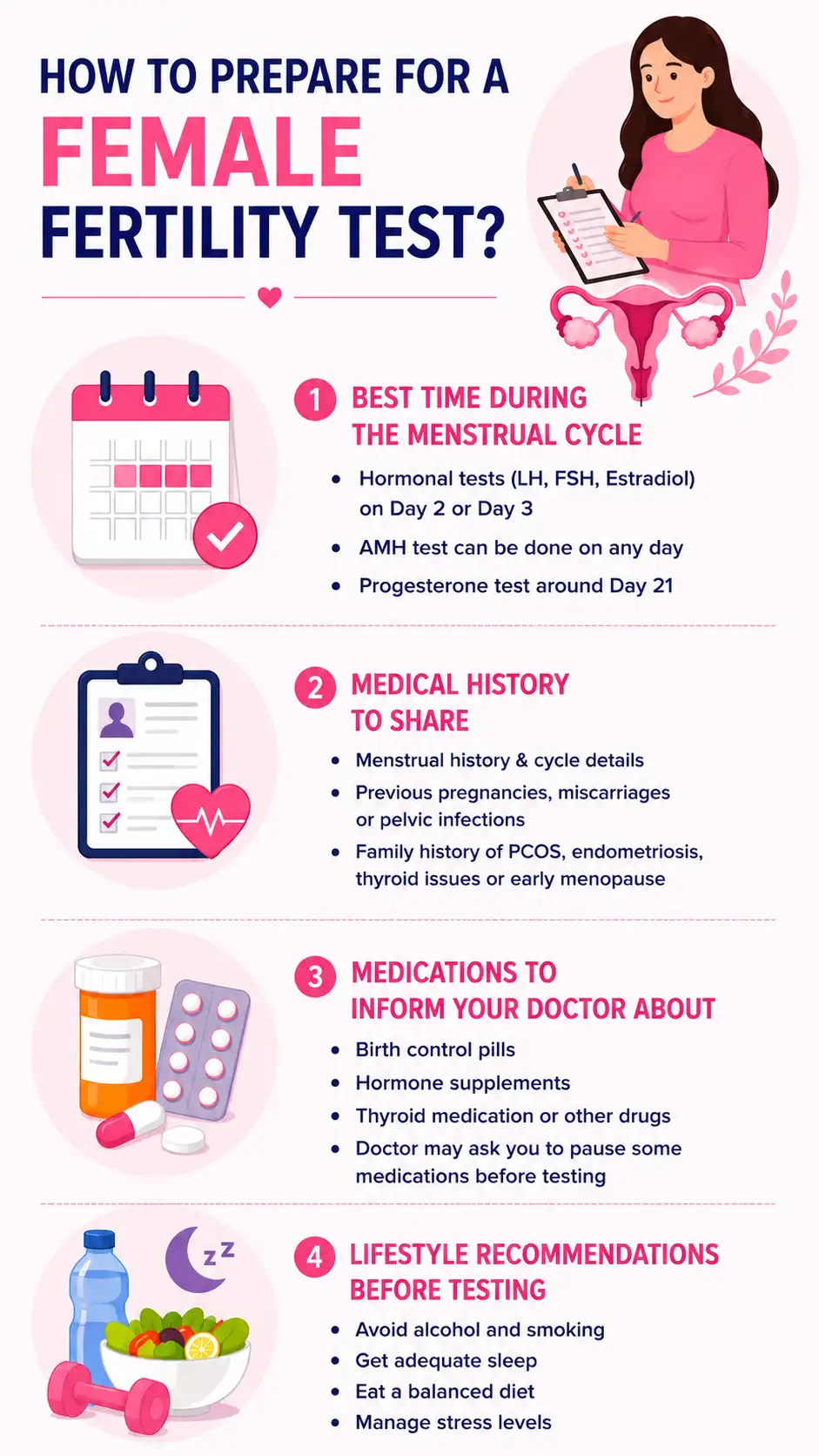
A little preparation can make your female fertility test results more accurate, and save you a repeat visit if timing or details get missed.
Best Time During the Menstrual Cycle
Timing matters a lot when it comes to fertility hormonal tests, including those like LH, FSH, and estradiol. These are common under any female fertility test name that you will see on a lab report. The best time for a hormonal test is on the Day 2 or Day 3 of your menstruation time, while AMH tests can be done on any day they do not change within days. The level of progesterone on the other hand is checked around Day 21 to confirm whether ovulation has occurred.
Medical History to Share
Come prepared to discuss your menstrual history, including cycle length, regularity, and any changes over time. It is also helpful to include any previous pregnancies, miscarriages, or pelvic infections, as well as a family history of problems such as PCOS, endometriosis, thyroid abnormalities, or early menopause. This background allows your doctor to determine which blood tests for fertility in female patients are actually required rather than conducting a generic panel.
Medications to Inform Your Doctor About
There are certain medications that can create issues with hormone levels and skew with your results. During the consultation tell your doctor about any medication you are taking, be it birth control pills, hormone supplements, thyroid medication or more. They might ask you to pause all medication before your female blood test for fertility to get accurate results. Do not stop any medication on your own though, always check with your doctor first.
Lifestyle Recommendations Before Testing
A few simple habits in the days leading up to your test can help ensure accurate results. These include avoiding excessive intake of alcohol or smoking. One must get adequate sleep, have a balanced diet and avoid high stress levels since these can affect hormone results.
Understanding Female Fertility Test Results
Normal results
Normal fertility test results indicate that important reproductive parameters like ovarian reserve, hormone levels, ovulation, and reproductive anatomy are within normal ranges.
Abnormal Hormone Levels
Hormonal changes such as AMH, FSH, LH, or thyroid hormones may alter ovulation or ovarian function and necessitate further investigation.
Low Ovarian Reserve
Low ovarian reserve suggests a limited quantity of remaining eggs. Your reproductive specialist can explain your alternatives based on your age and general fertility health.
Ovulation Disorders
Ovulation Disorders or inconsistent or missing ovulation can make conception more difficult. Identifying the underlying reason can aid in determining appropriate treatment.
Blocked Fallopian Tubes
Sperm and egg cannot normally meet if the fallopian tubes are blocked or damaged. Further evaluation can aid in determining appropriate treatment alternatives.
Uterine Abnormalities
Fibroids, polyps, adhesions, and other uterine abnormalities can sometimes interfere with implantation or pregnancy, necessitating additional evaluation.
Why Choose Birla Fertility for Diagnostic Test
Accurate diagnostics are the foundation of every fertility plan we build — here's what sets our testing experience apart.
120+
Fertility Experts
2 Lakh+
Patients Treated
50+
Clinics in India
NABL
Accredited Labs
Patient Experiences at Birla Fertility & IVF
Female Fertility Test Cost in India
The cost of female fertility tests in India varies according to the tests indicated, which include hormone blood tests, AMH testing, ultrasound, and fallopian tube examination. At Birla Fertility & IVF, preliminary female fertility studies range from ₹8,000 to ₹15,000, depending on individual needs.
An AMH test can cost between ₹2,530 and ₹2,750, while a transvaginal ultrasound can range from ₹800 to ₹1,200.
The precise cost depends on your fertility assessment and location.
Top IVF Centers in Popular Cities
- IVF Center in Delhi
- IVF Center in New Town Kolkata
- IVF Center in Gurgaon
- IVF Center in Rewari
- IVF Center in Lucknow
- IVF Center in Varanasi
- IVF Center in Gorakhpur
- IVF Center in Noida
- IVF Center in Prayagraj
- IVF Center in Meerut
- IVF Center in Kolkata
- IVF Center in Howrah
- IVF Center in Bhubaneswar
- IVF Center in Cuttack
- IVF Center in Surat
- IVF Center in Ahmedabad
- IVF Center in Ranchi
- IVF Center in Chandigarh
- IVF Center in Guwahati
- IVF Center in Raipur
- IVF Center in Jaipur
- IVF Center in Nagpur
- IVF Center in Hyderabad
- IVF Center in Indore
- IVF Center in Bhopal
- IVF Center in Kozhikode
- IVF Center in Kannur
- IVF Center in Mangalore
- IVF Center in Palakkad
- IVF Center in Salem
- IVF Center in Thrissur
- IVF Center in Bangalore
- IVF Center in Kolar
- IVF Center in Mumbai
- IVF Center in Vijayapura
- IVF Center in Chennai
- IVF Center in Patna
- IVF Center in Perinthalmanna
- IVF Center in Siliguri
- IVF Center in Gachibowli
Frequently Asked Questions
Hormone tests like FSH, LH, and estradiol are best done on Day 2 or 3 of your cycle, while AMH can be tested any day. Progesterone is checked around Day 21 to confirm ovulation.