
 Our Centers


Why Egg Freezing Is the Hottest Fertility Trend and Should You Join In?

Table of Contents
- What Is Egg Freezing and Why Does It Matter
- The Celebrity Effect: Breaking the Silence
- Should You Consider Egg Freezing? Five Compelling Reasons
- The Indian Advantage: Affordable World-Class Care
- Understanding the Process: What to Expect
- How Many Eggs Should You Freeze for One Baby
- Real Talk: What Actually Influences Your Results
- Potential Risks: What You Need to Know
- The Bigger Picture: Redefining Womanhood in Modern India
- Is Egg Freezing Right for You
- Taking the First Step
Priyanka Chopra chose to freeze her eggs in her early thirties. Sania Mirza has spoken about women owning their reproductive timelines. Mithali Raj has championed conversations around women balancing long careers with personal decisions. Diana Hayden welcomed her first child at 42 using her frozen eggs. Richa Chadha has openly discussed delaying motherhood to focus on her craft. Globally, names like Emma Roberts, Rebel Wilson and Lina Esco have shared their fertility preservation choices. Together, these women have turned egg freezing into one of the most relevant conversations in modern womanhood, in India and across the world.
What Is Egg Freezing and Why Does It Matter
Egg freezing, medically known as oocyte cryopreservation, is a process where a woman’s eggs are extracted, frozen and stored for future use. It works like hitting pause on your fertility timeline. Doctors stimulate the ovaries to grow multiple eggs, retrieve them in a short procedure and then freeze them through vitrification at ultra-low temperatures. Younger eggs have higher quality, so freezing them in your twenties or early thirties gives stronger outcomes when you return to use them later.
The Celebrity Effect: Breaking the Silence
Ekta Kapoor froze her eggs in her early thirties after a conversation with Karan Johar. She later became a single mother and continues to advocate for reproductive autonomy. Priyanka Chopra shared that she froze her eggs with encouragement from her mother Dr. Madhu Chopra and described it as a decision that gave her freedom and control. Diana Hayden gave birth at 42 using her frozen eggs and later had more children naturally. Mona Singh opted for egg freezing at 34 to prioritise her goals. Rakhi Sawant shared that she froze her eggs to focus on her career. Mehreen Pirzada underwent egg freezing at 28 and now speaks openly about reproductive choice. Tanishaa Mukerji froze her eggs at 39 to secure her motherhood options. These stories have helped normalise the idea that women can plan motherhood on their own time.
Should You Consider Egg Freezing? Five Compelling Reasons
-
Career First, Baby Later
Egg freezing removes the pressure of fitting motherhood into your career timeline. You are climbing the corporate ladder, building your startup or pursuing higher education. Your professional dreams should not come with a fertility expiration date.
-
Waiting for the Right Partner
You do not need to rush relationships because of fertility concerns. Not everyone meets their life partner in their twenties and that is perfectly okay. Egg freezing ensures you are not settling simply because of fertility pressure.
-
Medical Reasons
Women undergoing chemotherapy, pelvic radiation, ovarian surgeries or dealing with endometriosis and PCOS can preserve fertility before treatment. This option offers proactive protection before medical interventions that might compromise reproductive health.
-
Family History
Women with a family history of premature menopause or early ovarian failure can protect fertility early.
-
Personal Readiness
You may not feel ready for motherhood mentally, financially or emotionally. That is a strong and valid reason to freeze your eggs. Your body, your choice, your timeline.
The Indian Advantage: Affordable World-Class Care
Egg freezing in India costs between 1.5 lakhs and 2.5 lakhs for one cycle. Annual storage fees usually range from 10,000 to 25,000. Compare this to Western countries where the procedure can cost upwards of 10,000 to 15,000 dollars and you will see why medical tourism for fertility preservation is rising in India. Major cities such as Delhi, Mumbai, Bengaluru and Pune offer advanced IVF centers with trained embryologists and strong vitrification labs. The level of technology and expertise matches global standards.
Understanding the Process: What to Expect
Step 1: Consultation and Testing (5,000 to 10,000 rupees)
Your fertility specialist will assess your ovarian reserve through blood tests and ultrasounds.
Step 2: Ovarian Stimulation (50,000 to 80,000 rupees)
For 10 to 12 days, you self-administer hormonal injections to stimulate egg production.
Step 3: Egg Retrieval (30,000 to 50,000 rupees)
Under mild sedation, doctors retrieve mature eggs through a short procedure.
Step 4: Freezing and Storage (20,000 to 30,000 rupees initially, then 10,000 to 15,000 rupees per year)
Your eggs are flash-frozen using vitrification and stored in specialised tanks.
How Many Eggs Should You Freeze for One Baby
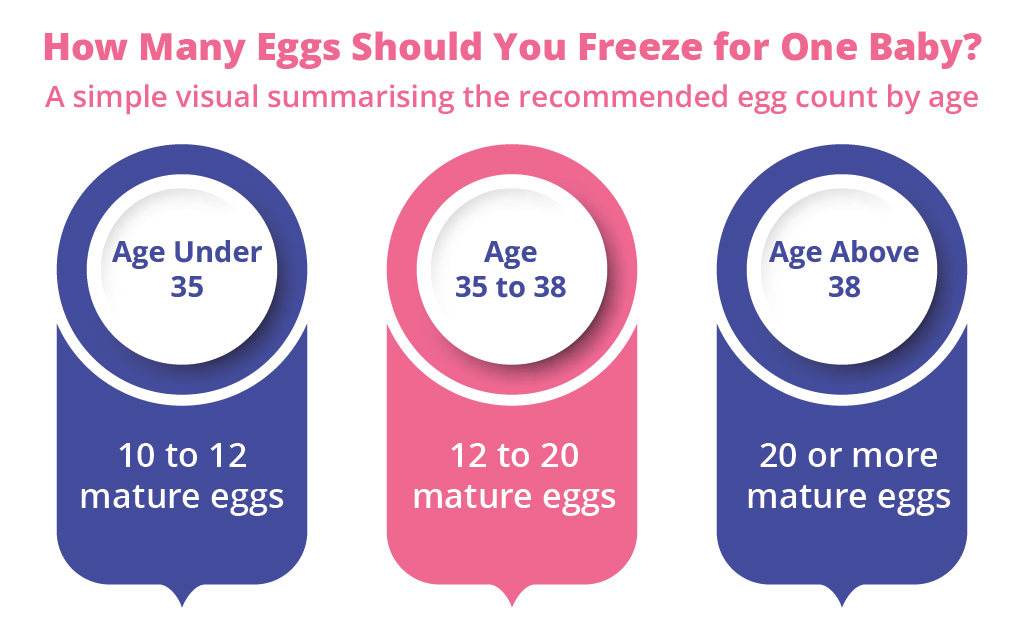
The most practical way to understand egg freezing is to look at how many eggs you need to freeze to aim for one healthy baby. Global clinical data recommends the following targets:
• Under 35: Freeze 10 to 12 mature eggs
• Age 35 to 38: Freeze 12 to 20 mature eggs
• Above 38: Often need 20 or more mature eggs across multiple cycles
The ideal number depends on ovarian reserve, egg maturity and age at the time of freezing. This planning helps estimate the number of cycles, timelines and costs.
Real Talk: What Actually Influences Your Results
Egg freezing works best when the right number of mature eggs is planned for your age. The outcome depends on biology, not a fixed survival number. Younger eggs have stronger developmental potential, which is why women who freeze before 35 usually need fewer eggs. The focus is not on how many eggs survive the freeze, but on how many mature eggs you freeze and how many eventually reach the embryo stage.
Potential Risks: What You Need to Know
Egg freezing is generally safe. Some women may experience ovarian hyperstimulation, mild discomfort, rare bleeding or infection or emotional strain related to hormones. There is no absolute guarantee of pregnancy, but choosing a reliable clinic with experienced embryologists reduces risks.
The Bigger Picture: Redefining Womanhood in Modern India
The revolution is cultural. For generations, Indian women were expected to marry young and prioritise motherhood early. Modern women are rewriting that script. When celebrities like Priyanka Chopra, Sania Mirza, Richa Chadha and Diana Hayden talk openly about reproductive choices, they send a powerful message. Women can have long careers, wait for the right partner or make decisions based on personal readiness. They can choose motherhood on their own terms.
Is Egg Freezing Right for You
You may consider egg freezing if you are in your late twenties to mid-thirties and not planning pregnancy soon, have health conditions that may affect future fertility, want clarity while focusing on career or personal goals or want biological children in the future but are not ready now. Speak with a specialist if you are over 35, have a family history of early menopause, are undergoing medical treatment that may affect fertility or have irregular cycles.
Taking the First Step
Egg freezing is an investment in your future choices. It gives you time, clarity and control. Whether you relate to Priyanka Chopra’s global career path, Sania Mirza’s voice on agency, Richa Chadha’s focus on her craft or Diana Hayden’s lived proof that fertility preservation works, your story is yours to write. The biological clock is real, but science now gives you the ability to pause it. The question is not whether you should freeze your eggs. The question is whether you want to. Your future self may be grateful that you explored your options today.
Our Fertility Specialists

Gurgaon – Sector 14, Haryana
Dr. Rashmika Gandhi
MBBS, MS, DNB

Gurgaon – Sector 14, Haryana
Dr. Prachi Benara
MBBS (Gold Medalist), MS (OBG), DNB (OBG), PG Diploma in Reproductive and Sexual health
Meerut, Uttar Pradesh
Dr. Madhulika Sharma
MBBS, DGO, DNB (Obstetrics and Gynaecology), PGD (Ultrasonography)
Chandigarh
Dr. Rakhi Goyal
MBBS, MD (Obstetrics and Gynaecology)
Lajpat Nagar, Delhi
Dr. Muskaan Chhabra
MBBS ,MS ( OBGYN ) , FRM
Kolkata, West Bengal
Dr. Swati Mishra
MBBS, MS (Obstetrics & Gynaecology)
Related Blogs





To know more
Birla Fertility & IVF aims at transforming the future of fertility globally, through outstanding clinical outcomes, research, innovation and compassionate care.


Had an IVF Failure?
Talk to our fertility experts