
 Our Centers
 Select City


 Select City

Fertility Files – Real Cases of Infertility Challenges
From Severe Uterine Damage to a Confirmed Pregnancy
18 years of infertility. A severely damaged uterine lining. Multiple medical challenges, including HIV. For years, pregnancy wasn’t just difficult, it seemed out of reach. Because even when embryos are available, implantation depends on one crucial factor: the uterus being ready. Today, she has achieved a confirmed pregnancy after a journey defined by persistence, precision, and regenerative care.
Case Snapshot
Journey Timeline

1. Complex Challenges

2. Personalised Plans

3. Safe Retireval & Transfer

4. Guided Transfer

5. Successful Pregnancy
The Barriers They Faced

Severely Thin & Irregular Endometrium
Not ideal for embryo implantation.

Dense Intrauterine Adhesions
Distorted and restricted the uterine cavity.

Long-Standing Infertility (18 years)
No prior successful pregnancy.

Advanced Maternal Age
Required donor oocytes for better success chances.

Endometrial Receptivity Issues
Even with embryos, implantation likelihood was low without intervention.
Doctor's Quote
“The key was to tailor every aspect of care to this patient's unique needs, balancing safety, comfort, and clinical effectiveness.”— Dr. Nimisha Shantilal Pandya
The Treatment Plan that made the Difference
Hormonal Preparation
The patient was started on estrogen therapy (Progynova) to stimulate endometrial growth. Initial scans showed a thin, patchy lining (6.5 mm), indicating the need for further intervention.
Hysteroscopic Correction
First Hysteroscopy: – Severely fibrosed, tunnel-shaped uterine cavity – Dense adhesions and a small polyp Procedures performed: – Adhesiolysis (removal of adhesions) – Polypectomy
PRP Therapy (Regenerative Approach)
Multiple intrauterine PRP (Platelet-Rich Plasma) sessions were administered to stimulate endometrial healing and growth. → Result: Mild improvement, but still not optimal

Advanced Surgical & Regenerative Intervention
A second hysteroscopy was performed with: – Further adhesiolysis – Dilatation & Curettage (D&C) – Sub-endometrial PRP injection Followed by continued hormonal therapy and additional PRP support.
Endometrial Optimisation
Follow-up showed improved endometrial thickness (6.9 mm) with better structure, sufficient to proceed with embryo transfer planning.
Donor IVF & Embryo Transfer
IVF was performed using donor oocytes. A double embryo transfer was carried out under carefully optimised conditions.
A Story of Rebuilding Hope
The Outcome
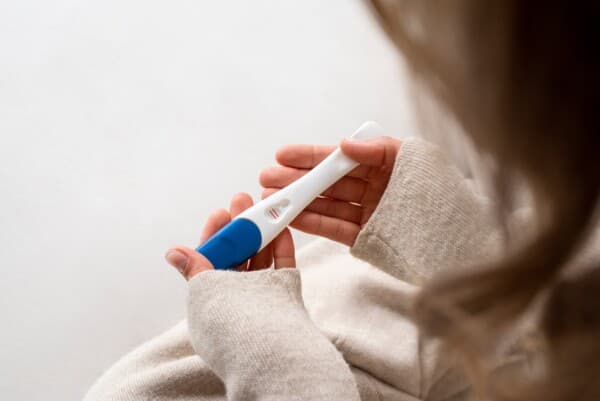
β-hCG levels were strongly positive (>1000 mIU/mL).
Ultrasound confirmed an intrauterine gestational sac, indicating a successful early pregnancy.